For offices, clinics, consulates and plants · UAE
The visitor register that runs itself.
A visitor taps their Emirates ID. Two seconds later the legal name, photograph and ID number are on a sealed record, a badge is out, and nobody has typed anything. The register stays on your premises and keeps working when the internet does not.
At the desk
Tap the ID. Two seconds. Badge out.
What arrives
A desk, a screen for the visitor, and your own PC.
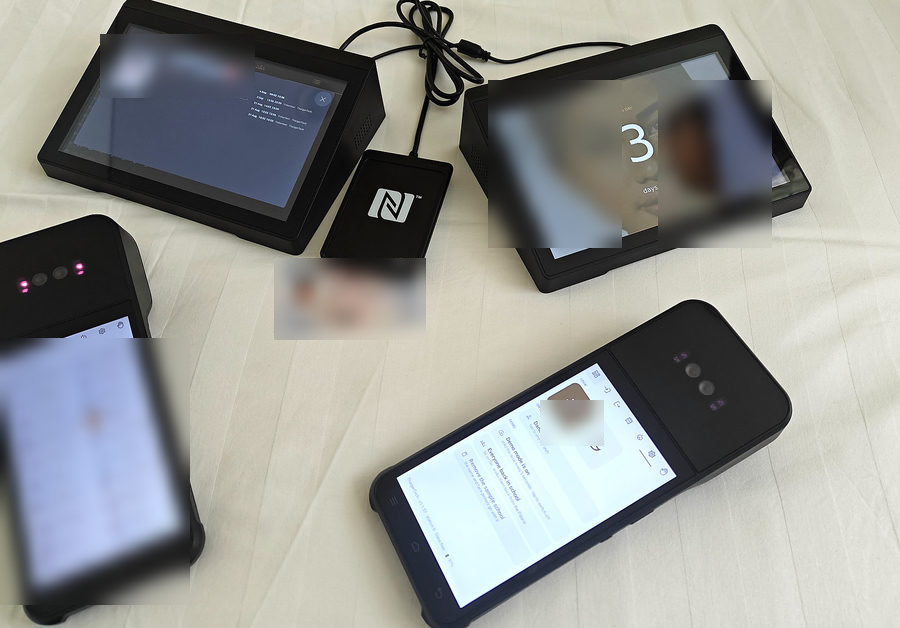
Two 10-inch stations sit on the reception counter. One faces the receptionist or guard and runs the desk. One faces the visitor: the notice board while nobody is signing, their own details and the signature when they are. The Back Office on an office PC holds the planning, the reports and the exports. Every unit holds the same register, so the desk keeps working when the PC is off.
2 front desks
Two stations with the Emirates ID reader, joined by one Ethernet cable. Either can take over the other's job in a tap, so the second is also your spare.
Back Office
A PC application for the office: expected visitors imported from your spreadsheet or booking export, who is in right now, visits by week and by reason, XLSX and PDF exports with an integrity code.
Badges and cards
A pack of visitor cards, each tied to the visit it was handed out for and collected at the end of it.
Nothing to install
One cable between the two desks, nothing on a server, no account to create. If you want the desk live on an office PC, the desks need a route to it; the IT page has the ports.
A day at reception
A working day in four moments.
08:55
The contractor is expected
The desk already knows: the visit was imported from the planning yesterday. The tap confirms who arrived, and the badge is out.
10:30
A walk-in arrives
Emirates ID in. Name, ID number and photograph from the chip, reason and host from the screen, signature on the glass. The seven fields, no pen.
14:00
A regular returns
Recognised from the stored, photo-confirmed record. The reason and company from last time are already filled in. Faster than the first visit.
Alarm
Everyone accounted for
The desk runs on battery and walks to the assembly point as the live roll call: everyone checked in and not yet out, ticked off as they stand in front of you.
Watch
A visitor, from the tap to the card coming back.
What changes on Monday
Three people, one Monday.
The visitor
Before: a form on a clipboard, a name spelled from a script the guard does not read, a lanyard, and the same again next week.
Monday: a tap, a signature, a badge. Two seconds, and the record is right.
The receptionist
Before: a binder, a pen, a phone call to the host, and no idea who is still in the building at six.
Monday: a photo and three big buttons. The screen says who is expected, who is in, and who is late.
You
Before: "who was here on the 14th?" is an afternoon with a binder, and an audit is a week of photocopying.
Monday: one click exports the log, with an integrity code, and every name on it came from a chip, not a pen.
Proof
Three things you can check yourself.
Watch it read a card
We bring the kit to your reception. Tap your own Emirates ID and time it. Book the visit.
Show it to your IT team
The ports, one direction, nothing to the internet, and what a stranger on the LAN sees. It is all on the IT page, written for the person who owns the VLANs.
Ask who built it
The people who wrote the software are on the company profile by name, and they answer the phone.
Before you ask
The questions every facility manager asks.
Who do I contract with?
Thaiger Board Solutions L.L.C., Abu Dhabi, trade licence CN-5010084, registered Abu Dhabi Government Procurement (ADGPG) supplier no. 206940. Quotation in AED, paid against your LPO. Trade licence and bank letter are on request.
What about visitors without an Emirates ID?
The passport is scanned at the desk, its machine-readable strip read, and the visitor checks in through exactly the same path with the same sealed record. The chip is the fast path, not the only path.
Can I load tomorrow's visitors?
Yes. Whatever you plan in today, a spreadsheet or a booking system's export, imports as planned visitors. Arrival becomes a confirmation instead of an interview.
What happens when a unit breaks?
The other desk keeps the register running, because both hold it. We swap the broken unit and the register restores itself to the replacement. Hardware carries a three-year warranty.
Where is my data?
In your building, on your devices, encrypted. Retention is enforced by the device itself. Exports to XLSX and PDF whenever you need them. We never hold a copy.
What does our IT team need to do?
Nothing, if the desk runs on its own. If you want the Back Office live on an office PC: an RJ45 drop or WiFi access for the desks, a VLAN if you prefer, and a few ports in one direction, listed on the IT page.
What if ThaigerTech disappears?
The desk keeps working, because it does not depend on us: no server, no licence check, no renewal. Source escrow is available on request.
What do we pay after the first year?
Nothing, unless you want that year's releases. Updates and support are AED 2,000 per site per year, the first year included. Stop paying and you keep every version you have, forever; you only stop receiving new ones. Bug fixes are always free, and fixes that touch safety or your data ship to every site regardless.
Priced on quotation, one-off, with no subscription. The stations are the same hardware as the school kits on the pricing page, AED 2,250 each.